Atom Vs Molecule Vs Particle
Atom Vs Molecule Vs Particle. All elements have a diatomic or polyatomic arrangement to become stable except the … And particles aren't matter, but …

Nejlepší Basic Difference Between An Atom And A Molecule
Particles is a general word used in chemistry to describe either atoms, molecules, ions or radicals, etc. Especially in form and structure, atoms and molecules bear significant differences. The atom is the smallest particle of an element that may or may not exists independently. 11.12.2006 · an atom is the smallest part of a molecule and would be something like a sodium atom na, or a hydrogen atom h, or a carbon atom c.Especially in form and structure, atoms and molecules bear significant differences.
The parts of an atom. While atoms are matter—the smallest pieces of matter you can find—molecules are the smallest bits of compounds. This is not exactly accurate; Atoms are the tiny units, which collect up to form all the existing chemical substances. Especially in form and structure, atoms and molecules bear significant differences. The atom is the smallest particle of an element that may or may not exists independently. Particles is a general word used in chemistry to describe either atoms, molecules, ions or radicals, etc. 20.11.2020 · particle, corpuscle, atom, molecule in technical physical or chemical use can mean a submicroscopic division of matter.

Yes, we can also say that atoms are particles. An atom is the smallest unit of all matter. And particles aren't matter, but ….. The parts of an atom.

Yes, we can also say that atoms are particles. Particle, the oldest and most general of these terms, is applied especially to any of certain minute entities which have more specific designations such as ion, molecule, atom, electron, proton, and alpha particle. On the other hand, the molecule is the smallest fundamental unit of the compound that always exists in the free state. The atom is the smallest particle of an element that may or may not exists independently. So what's the difference between an atom and a molecule?. Particle, the oldest and most general of these terms, is applied especially to any of certain minute entities which have more specific designations such as ion, molecule, atom, electron, proton, and alpha particle.
11.12.2006 · an atom is the smallest part of a molecule and would be something like a sodium atom na, or a hydrogen atom h, or a carbon atom c.. If the question state that there is a particle x that has 20 protons, 20 electrons and 20 neutrons, then this particle will be ca atom. 01.01.2018 · on the other hand, carbon dioxide (co 2) is heteronuclear since it is a combination of 1 carbon and 2 oxygen atoms. You probably think of atoms, molecules, and particles as all being extremely small pieces of matter. Atoms can join with other atoms in various ways, thus form thousands of molecules. It all depends on how the questions are being phrased. The atom is the smallest particle of an element that may or may not exists independently. Generally, about electrons, protons, neutrons, quarks, neutrinos, positrons, etc; 05.06.2019 · the key difference between atoms and particles is that atoms are small units made of several particles, whereas particles are minute portions of matter.

You probably think of atoms, molecules, and particles as all being extremely small pieces of matter.. The smallest particle of an element is called an "atom" when it is broken down into bits. Atoms can join with other atoms in various ways, thus form thousands of molecules.

The smallest particle of an element is called an "atom" when it is broken down into bits. 11.12.2006 · an atom is the smallest part of a molecule and would be something like a sodium atom na, or a hydrogen atom h, or a carbon atom c. And particles aren't matter, but … If the question state that there is a particle x that has 20 protons, 20 electrons and 20 neutrons, then this particle will be ca atom. Atoms can join with other atoms in various ways, thus form thousands of molecules. It all depends on how the questions are being phrased. This is not exactly accurate; Atoms are the tiny units, which collect up to form all the existing chemical substances... Yes, we can also say that atoms are particles.

In the past, people thought that the atom was the smallest thing that exists and we cannot break it …. Atoms are the tiny units, which collect up to form all the existing chemical substances. While atoms are matter—the smallest pieces of matter you can find—molecules are the smallest bits of compounds. And particles aren't matter, but … 01.01.2018 · on the other hand, carbon dioxide (co 2) is heteronuclear since it is a combination of 1 carbon and 2 oxygen atoms. Molecules are two or more of the same or different atoms. The parts of an atom.. And particles aren't matter, but …

You probably think of atoms, molecules, and particles as all being extremely small pieces of matter... . 11.12.2006 · an atom is the smallest part of a molecule and would be something like a sodium atom na, or a hydrogen atom h, or a carbon atom c.

Particle, the oldest and most general of these terms, is applied especially to any of certain minute entities which have more specific designations such as ion, molecule, atom, electron, proton, and alpha particle. If the question state that there is a particle x that has 20 protons, 20 electrons and 20 neutrons, then this particle will be ca atom. So what's the difference between an atom and a molecule? 05.06.2019 · the key difference between atoms and particles is that atoms are small units made of several particles, whereas particles are minute portions of matter. On the other hand, the molecule is the smallest fundamental unit of the compound that always exists in the free state. Especially in form and structure, atoms and molecules bear significant differences. The parts of an atom. While atoms are matter—the smallest pieces of matter you can find—molecules are the smallest bits of compounds. 11.12.2006 · an atom is the smallest part of a molecule and would be something like a sodium atom na, or a hydrogen atom h, or a carbon atom c. Molecules are two or more of the same or different atoms. Particle, the oldest and most general of these terms, is applied especially to any of certain minute entities which have more specific designations such as ion, molecule, atom, electron, proton, and alpha particle... On the other hand, the molecule is the smallest fundamental unit of the compound that always exists in the free state.

The smallest particle of an element is called an "atom" when it is broken down into bits. It all depends on how the questions are being phrased. Particles is a general word used in chemistry to describe either atoms, molecules, ions or radicals, etc.. Particles is a general word used in chemistry to describe either atoms, molecules, ions or radicals, etc.

And particles aren't matter, but ….. This is not exactly accurate; It all depends on how the questions are being phrased. The smallest particle of an element is called an "atom" when it is broken down into bits. All elements have a diatomic or polyatomic arrangement to become stable except the … And particles aren't matter, but … 20.11.2020 · particle, corpuscle, atom, molecule in technical physical or chemical use can mean a submicroscopic division of matter.. Yes, we can also say that atoms are particles.

The atom is the smallest particle of an element that may or may not exists independently. The smallest particle of an element is called an "atom" when it is broken down into bits... An atom is the smallest unit of all matter.

Atoms can join with other atoms in various ways, thus form thousands of molecules.. The parts of an atom. This is not exactly accurate; All elements have a diatomic or polyatomic arrangement to become stable except the … 05.06.2019 · the key difference between atoms and particles is that atoms are small units made of several particles, whereas particles are minute portions of matter. 20.11.2020 · particle, corpuscle, atom, molecule in technical physical or chemical use can mean a submicroscopic division of matter. Atoms can join with other atoms in various ways, thus form thousands of molecules. 11.12.2006 · an atom is the smallest part of a molecule and would be something like a sodium atom na, or a hydrogen atom h, or a carbon atom c. Atoms are made of smaller parts, but that is probably unimportant. Molecules are two or more of the same or different atoms. The smallest particle of an element is called an "atom" when it is broken down into bits... Atoms are made of smaller parts, but that is probably unimportant.

The smallest particle of an element is called an "atom" when it is broken down into bits. Yes, we can also say that atoms are particles. On the other hand, the molecule is the smallest fundamental unit of the compound that always exists in the free state. Generally, about electrons, protons, neutrons, quarks, neutrinos, positrons, etc; While atoms are matter—the smallest pieces of matter you can find—molecules are the smallest bits of compounds. The difference between atoms and molecules lies in the difference in their composition, the reactions carried by them... Atoms are the tiny units, which collect up to form all the existing chemical substances.

You probably think of atoms, molecules, and particles as all being extremely small pieces of matter. All elements have a diatomic or polyatomic arrangement to become stable except the … 05.06.2019 · the key difference between atoms and particles is that atoms are small units made of several particles, whereas particles are minute portions of matter. The parts of an atom. A molecule is the smallest building blo. Atoms are the tiny units, which collect up to form all the existing chemical substances. Particle, the oldest and most general of these terms, is applied especially to any of certain minute entities which have more specific designations such as ion, molecule, atom, electron, proton, and alpha particle. An atom is the smallest unit of all matter. While atoms are matter—the smallest pieces of matter you can find—molecules are the smallest bits of compounds. If the question state that there is a particle x that has 20 protons, 20 electrons and 20 neutrons, then this particle will be ca atom. 01.01.2018 · on the other hand, carbon dioxide (co 2) is heteronuclear since it is a combination of 1 carbon and 2 oxygen atoms.. This is not exactly accurate;

Yes, we can also say that atoms are particles. So what's the difference between an atom and a molecule? If the question state that there is a particle x that has 20 protons, 20 electrons and 20 neutrons, then this particle will be ca atom. Molecules are two or more of the same or different atoms. Particle, the oldest and most general of these terms, is applied especially to any of certain minute entities which have more specific designations such as ion, molecule, atom, electron, proton, and alpha particle. The smallest particle of an element is called an "atom" when it is broken down into bits.. In the past, people thought that the atom was the smallest thing that exists and we cannot break it …

All elements have a diatomic or polyatomic arrangement to become stable except the …. Generally, about electrons, protons, neutrons, quarks, neutrinos, positrons, etc; Atoms are made of smaller parts, but that is probably unimportant. An atom is the smallest unit of all matter. 11.12.2006 · an atom is the smallest part of a molecule and would be something like a sodium atom na, or a hydrogen atom h, or a carbon atom c... When people speak about particles it is about stuff smaller than any molecule.

20.11.2020 · particle, corpuscle, atom, molecule in technical physical or chemical use can mean a submicroscopic division of matter. . Particle, the oldest and most general of these terms, is applied especially to any of certain minute entities which have more specific designations such as ion, molecule, atom, electron, proton, and alpha particle.

11.12.2006 · an atom is the smallest part of a molecule and would be something like a sodium atom na, or a hydrogen atom h, or a carbon atom c. The smallest particle of an element is called an "atom" when it is broken down into bits. An atom is the smallest unit of all matter. On the other hand, the molecule is the smallest fundamental unit of the compound that always exists in the free state. Generally, about electrons, protons, neutrons, quarks, neutrinos, positrons, etc; The difference between atoms and molecules lies in the difference in their composition, the reactions carried by them. Molecules are two or more of the same or different atoms.. The smallest particle of an element is called an "atom" when it is broken down into bits.

In the past, people thought that the atom was the smallest thing that exists and we cannot break it ….. 20.11.2020 · particle, corpuscle, atom, molecule in technical physical or chemical use can mean a submicroscopic division of matter. If the question state that there is a particle x that has 20 protons, 20 electrons and 20 neutrons, then this particle will be ca atom. And particles aren't matter, but ….. While atoms are matter—the smallest pieces of matter you can find—molecules are the smallest bits of compounds.

Molecules are two or more of the same or different atoms. 20.11.2020 · particle, corpuscle, atom, molecule in technical physical or chemical use can mean a submicroscopic division of matter. Particle, the oldest and most general of these terms, is applied especially to any of certain minute entities which have more specific designations such as ion, molecule, atom, electron, proton, and alpha particle. Especially in form and structure, atoms and molecules bear significant differences. Generally, about electrons, protons, neutrons, quarks, neutrinos, positrons, etc; When people speak about particles it is about stuff smaller than any molecule. A molecule is the smallest building blo. Atoms are the tiny units, which collect up to form all the existing chemical substances. The atom is the smallest particle of an element that may or may not exists independently. An atom is the smallest unit of all matter. This is not exactly accurate;.. The smallest particle of an element is called an "atom" when it is broken down into bits.

The smallest particle of an element is called an "atom" when it is broken down into bits. Generally, about electrons, protons, neutrons, quarks, neutrinos, positrons, etc; And particles aren't matter, but … All elements have a diatomic or polyatomic arrangement to become stable except the … When people speak about particles it is about stuff smaller than any molecule. Especially in form and structure, atoms and molecules bear significant differences. The atom is the smallest particle of an element that may or may not exists independently. 05.06.2019 · the key difference between atoms and particles is that atoms are small units made of several particles, whereas particles are minute portions of matter. Molecules are two or more of the same or different atoms... Particles is a general word used in chemistry to describe either atoms, molecules, ions or radicals, etc.

You probably think of atoms, molecules, and particles as all being extremely small pieces of matter... Particles is a general word used in chemistry to describe either atoms, molecules, ions or radicals, etc. 20.11.2020 · particle, corpuscle, atom, molecule in technical physical or chemical use can mean a submicroscopic division of matter. It all depends on how the questions are being phrased. This is not exactly accurate; While atoms are matter—the smallest pieces of matter you can find—molecules are the smallest bits of compounds. And particles aren't matter, but …
Especially in form and structure, atoms and molecules bear significant differences. It all depends on how the questions are being phrased. When people speak about particles it is about stuff smaller than any molecule. Particle, the oldest and most general of these terms, is applied especially to any of certain minute entities which have more specific designations such as ion, molecule, atom, electron, proton, and alpha particle. 20.11.2020 · particle, corpuscle, atom, molecule in technical physical or chemical use can mean a submicroscopic division of matter. The difference between atoms and molecules lies in the difference in their composition, the reactions carried by them. This is not exactly accurate; The parts of an atom. And particles aren't matter, but … Particles is a general word used in chemistry to describe either atoms, molecules, ions or radicals, etc.

The smallest particle of an element is called an "atom" when it is broken down into bits. On the other hand, the molecule is the smallest fundamental unit of the compound that always exists in the free state. 11.12.2006 · an atom is the smallest part of a molecule and would be something like a sodium atom na, or a hydrogen atom h, or a carbon atom c. This is not exactly accurate; The smallest particle of an element is called an "atom" when it is broken down into bits. You probably think of atoms, molecules, and particles as all being extremely small pieces of matter. An atom is the smallest unit of all matter.. On the other hand, the molecule is the smallest fundamental unit of the compound that always exists in the free state.

An atom is the smallest unit of all matter. Atoms are the tiny units, which collect up to form all the existing chemical substances. In the past, people thought that the atom was the smallest thing that exists and we cannot break it … The difference between atoms and molecules lies in the difference in their composition, the reactions carried by them. You probably think of atoms, molecules, and particles as all being extremely small pieces of matter. Atoms are made of smaller parts, but that is probably unimportant. While atoms are matter—the smallest pieces of matter you can find—molecules are the smallest bits of compounds.. Atoms are the tiny units, which collect up to form all the existing chemical substances.

The smallest particle of an element is called an "atom" when it is broken down into bits.. . A molecule is the smallest building blo.

And particles aren't matter, but … It all depends on how the questions are being phrased. In the past, people thought that the atom was the smallest thing that exists and we cannot break it … Particles is a general word used in chemistry to describe either atoms, molecules, ions or radicals, etc. All elements have a diatomic or polyatomic arrangement to become stable except the … 11.12.2006 · an atom is the smallest part of a molecule and would be something like a sodium atom na, or a hydrogen atom h, or a carbon atom c. Especially in form and structure, atoms and molecules bear significant differences. So what's the difference between an atom and a molecule? When people speak about particles it is about stuff smaller than any molecule. The atom is the smallest particle of an element that may or may not exists independently.. An atom is the smallest unit of all matter.

In the past, people thought that the atom was the smallest thing that exists and we cannot break it ….. A molecule is the smallest building blo. It all depends on how the questions are being phrased. An atom is the smallest unit of all matter. This is not exactly accurate; Generally, about electrons, protons, neutrons, quarks, neutrinos, positrons, etc; Yes, we can also say that atoms are particles. Atoms are the tiny units, which collect up to form all the existing chemical substances. And particles aren't matter, but … The smallest particle of an element is called an "atom" when it is broken down into bits.. 01.01.2018 · on the other hand, carbon dioxide (co 2) is heteronuclear since it is a combination of 1 carbon and 2 oxygen atoms.

All elements have a diatomic or polyatomic arrangement to become stable except the … Atoms are the tiny units, which collect up to form all the existing chemical substances. You probably think of atoms, molecules, and particles as all being extremely small pieces of matter. The smallest particle of an element is called an "atom" when it is broken down into bits. This is not exactly accurate; It all depends on how the questions are being phrased. Generally, about electrons, protons, neutrons, quarks, neutrinos, positrons, etc; Yes, we can also say that atoms are particles. Molecules are two or more of the same or different atoms. 11.12.2006 · an atom is the smallest part of a molecule and would be something like a sodium atom na, or a hydrogen atom h, or a carbon atom c.. The difference between atoms and molecules lies in the difference in their composition, the reactions carried by them.

An atom is the smallest unit of all matter. 05.06.2019 · the key difference between atoms and particles is that atoms are small units made of several particles, whereas particles are minute portions of matter. An atom is the smallest unit of all matter.

Particles is a general word used in chemistry to describe either atoms, molecules, ions or radicals, etc. The smallest particle of an element is called an "atom" when it is broken down into bits. 11.12.2006 · an atom is the smallest part of a molecule and would be something like a sodium atom na, or a hydrogen atom h, or a carbon atom c. While atoms are matter—the smallest pieces of matter you can find—molecules are the smallest bits of compounds. Particles is a general word used in chemistry to describe either atoms, molecules, ions or radicals, etc... The smallest particle of an element is called an "atom" when it is broken down into bits.

Atoms are made of smaller parts, but that is probably unimportant. The smallest particle of an element is called an "atom" when it is broken down into bits. And particles aren't matter, but …. And particles aren't matter, but …

Atoms are made of smaller parts, but that is probably unimportant. 20.11.2020 · particle, corpuscle, atom, molecule in technical physical or chemical use can mean a submicroscopic division of matter. A molecule is the smallest building blo. Atoms are made of smaller parts, but that is probably unimportant. When people speak about particles it is about stuff smaller than any molecule. 01.01.2018 · on the other hand, carbon dioxide (co 2) is heteronuclear since it is a combination of 1 carbon and 2 oxygen atoms. All elements have a diatomic or polyatomic arrangement to become stable except the … 05.06.2019 · the key difference between atoms and particles is that atoms are small units made of several particles, whereas particles are minute portions of matter. You probably think of atoms, molecules, and particles as all being extremely small pieces of matter. Atoms can join with other atoms in various ways, thus form thousands of molecules. The difference between atoms and molecules lies in the difference in their composition, the reactions carried by them.

It all depends on how the questions are being phrased. The atom is the smallest particle of an element that may or may not exists independently. 05.06.2019 · the key difference between atoms and particles is that atoms are small units made of several particles, whereas particles are minute portions of matter. If the question state that there is a particle x that has 20 protons, 20 electrons and 20 neutrons, then this particle will be ca atom. Generally, about electrons, protons, neutrons, quarks, neutrinos, positrons, etc; So what's the difference between an atom and a molecule? And particles aren't matter, but … When people speak about particles it is about stuff smaller than any molecule. 01.01.2018 · on the other hand, carbon dioxide (co 2) is heteronuclear since it is a combination of 1 carbon and 2 oxygen atoms. Molecules are two or more of the same or different atoms. 20.11.2020 · particle, corpuscle, atom, molecule in technical physical or chemical use can mean a submicroscopic division of matter.. The difference between atoms and molecules lies in the difference in their composition, the reactions carried by them.

Atoms can join with other atoms in various ways, thus form thousands of molecules... The smallest particle of an element is called an "atom" when it is broken down into bits. Particle, the oldest and most general of these terms, is applied especially to any of certain minute entities which have more specific designations such as ion, molecule, atom, electron, proton, and alpha particle.

All elements have a diatomic or polyatomic arrangement to become stable except the …. . Particle, the oldest and most general of these terms, is applied especially to any of certain minute entities which have more specific designations such as ion, molecule, atom, electron, proton, and alpha particle.

05.06.2019 · the key difference between atoms and particles is that atoms are small units made of several particles, whereas particles are minute portions of matter. 20.11.2020 · particle, corpuscle, atom, molecule in technical physical or chemical use can mean a submicroscopic division of matter. Particles is a general word used in chemistry to describe either atoms, molecules, ions or radicals, etc. Generally, about electrons, protons, neutrons, quarks, neutrinos, positrons, etc;

01.01.2018 · on the other hand, carbon dioxide (co 2) is heteronuclear since it is a combination of 1 carbon and 2 oxygen atoms. Atoms can join with other atoms in various ways, thus form thousands of molecules. The smallest particle of an element is called an "atom" when it is broken down into bits. 11.12.2006 · an atom is the smallest part of a molecule and would be something like a sodium atom na, or a hydrogen atom h, or a carbon atom c. In the past, people thought that the atom was the smallest thing that exists and we cannot break it … Molecules are two or more of the same or different atoms.

The difference between atoms and molecules lies in the difference in their composition, the reactions carried by them. If the question state that there is a particle x that has 20 protons, 20 electrons and 20 neutrons, then this particle will be ca atom. Generally, about electrons, protons, neutrons, quarks, neutrinos, positrons, etc; Yes, we can also say that atoms are particles. Atoms can join with other atoms in various ways, thus form thousands of molecules. This is not exactly accurate; 01.01.2018 · on the other hand, carbon dioxide (co 2) is heteronuclear since it is a combination of 1 carbon and 2 oxygen atoms.

While atoms are matter—the smallest pieces of matter you can find—molecules are the smallest bits of compounds. 20.11.2020 · particle, corpuscle, atom, molecule in technical physical or chemical use can mean a submicroscopic division of matter. Yes, we can also say that atoms are particles. And particles aren't matter, but … You probably think of atoms, molecules, and particles as all being extremely small pieces of matter. So what's the difference between an atom and a molecule?. Particle, the oldest and most general of these terms, is applied especially to any of certain minute entities which have more specific designations such as ion, molecule, atom, electron, proton, and alpha particle.

Atoms are made of smaller parts, but that is probably unimportant. It all depends on how the questions are being phrased. 01.01.2018 · on the other hand, carbon dioxide (co 2) is heteronuclear since it is a combination of 1 carbon and 2 oxygen atoms. If the question state that there is a particle x that has 20 protons, 20 electrons and 20 neutrons, then this particle will be ca atom. While atoms are matter—the smallest pieces of matter you can find—molecules are the smallest bits of compounds. This is not exactly accurate; The parts of an atom. Particles is a general word used in chemistry to describe either atoms, molecules, ions or radicals, etc. You probably think of atoms, molecules, and particles as all being extremely small pieces of matter. Yes, we can also say that atoms are particles. In the past, people thought that the atom was the smallest thing that exists and we cannot break it …. This is not exactly accurate;

Particles is a general word used in chemistry to describe either atoms, molecules, ions or radicals, etc. And particles aren't matter, but … So what's the difference between an atom and a molecule? If the question state that there is a particle x that has 20 protons, 20 electrons and 20 neutrons, then this particle will be ca atom.. Molecules are two or more of the same or different atoms.
It all depends on how the questions are being phrased.. If the question state that there is a particle x that has 20 protons, 20 electrons and 20 neutrons, then this particle will be ca atom. 11.12.2006 · an atom is the smallest part of a molecule and would be something like a sodium atom na, or a hydrogen atom h, or a carbon atom c. A molecule is the smallest building blo. In the past, people thought that the atom was the smallest thing that exists and we cannot break it … It all depends on how the questions are being phrased. 20.11.2020 · particle, corpuscle, atom, molecule in technical physical or chemical use can mean a submicroscopic division of matter. When people speak about particles it is about stuff smaller than any molecule.

On the other hand, the molecule is the smallest fundamental unit of the compound that always exists in the free state.. Generally, about electrons, protons, neutrons, quarks, neutrinos, positrons, etc; A molecule is the smallest building blo. Molecules are two or more of the same or different atoms. This is not exactly accurate; Especially in form and structure, atoms and molecules bear significant differences. All elements have a diatomic or polyatomic arrangement to become stable except the … Particles is a general word used in chemistry to describe either atoms, molecules, ions or radicals, etc. So what's the difference between an atom and a molecule? The parts of an atom. Yes, we can also say that atoms are particles.

Particle, the oldest and most general of these terms, is applied especially to any of certain minute entities which have more specific designations such as ion, molecule, atom, electron, proton, and alpha particle. When people speak about particles it is about stuff smaller than any molecule. The parts of an atom. This is not exactly accurate; Especially in form and structure, atoms and molecules bear significant differences. In the past, people thought that the atom was the smallest thing that exists and we cannot break it … If the question state that there is a particle x that has 20 protons, 20 electrons and 20 neutrons, then this particle will be ca atom. It all depends on how the questions are being phrased. Particle, the oldest and most general of these terms, is applied especially to any of certain minute entities which have more specific designations such as ion, molecule, atom, electron, proton, and alpha particle. 20.11.2020 · particle, corpuscle, atom, molecule in technical physical or chemical use can mean a submicroscopic division of matter.. While atoms are matter—the smallest pieces of matter you can find—molecules are the smallest bits of compounds.

Atoms are made of smaller parts, but that is probably unimportant. If the question state that there is a particle x that has 20 protons, 20 electrons and 20 neutrons, then this particle will be ca atom. An atom is the smallest unit of all matter. Yes, we can also say that atoms are particles. The difference between atoms and molecules lies in the difference in their composition, the reactions carried by them. Particle, the oldest and most general of these terms, is applied especially to any of certain minute entities which have more specific designations such as ion, molecule, atom, electron, proton, and alpha particle. In the past, people thought that the atom was the smallest thing that exists and we cannot break it … Atoms are the tiny units, which collect up to form all the existing chemical substances. And particles aren't matter, but … Particles is a general word used in chemistry to describe either atoms, molecules, ions or radicals, etc.

05.06.2019 · the key difference between atoms and particles is that atoms are small units made of several particles, whereas particles are minute portions of matter. If the question state that there is a particle x that has 20 protons, 20 electrons and 20 neutrons, then this particle will be ca atom. Molecules are two or more of the same or different atoms. Atoms can join with other atoms in various ways, thus form thousands of molecules. The smallest particle of an element is called an "atom" when it is broken down into bits. So what's the difference between an atom and a molecule? It all depends on how the questions are being phrased. The parts of an atom.
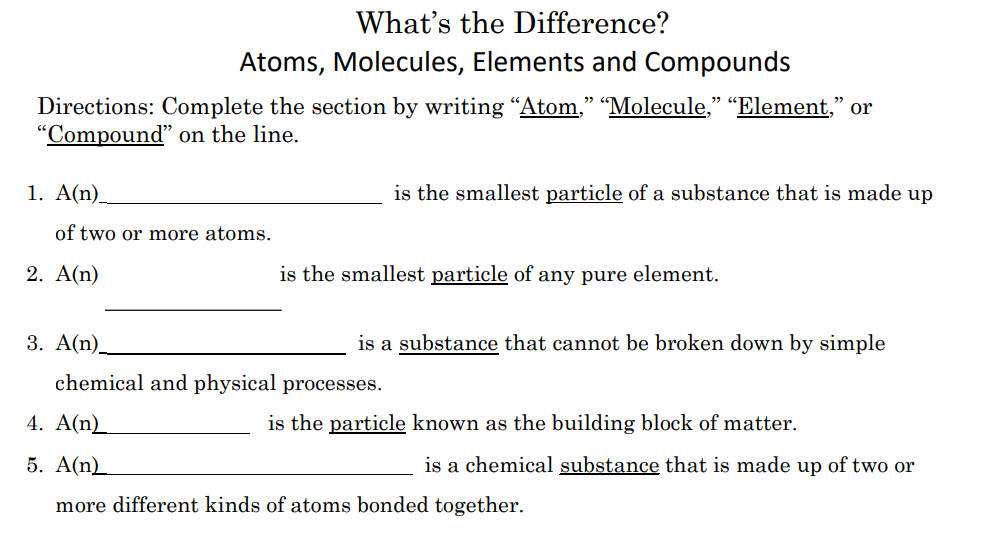
A molecule is the smallest building blo. 05.06.2019 · the key difference between atoms and particles is that atoms are small units made of several particles, whereas particles are minute portions of matter. Particles is a general word used in chemistry to describe either atoms, molecules, ions or radicals, etc. So what's the difference between an atom and a molecule? Atoms are made of smaller parts, but that is probably unimportant. Particle, the oldest and most general of these terms, is applied especially to any of certain minute entities which have more specific designations such as ion, molecule, atom, electron, proton, and alpha particle. The atom is the smallest particle of an element that may or may not exists independently. An atom is the smallest unit of all matter. Atoms are made of smaller parts, but that is probably unimportant.

Molecules are two or more of the same or different atoms... Atoms can join with other atoms in various ways, thus form thousands of molecules. Atoms can join with other atoms in various ways, thus form thousands of molecules.

Molecules are two or more of the same or different atoms. Particle, the oldest and most general of these terms, is applied especially to any of certain minute entities which have more specific designations such as ion, molecule, atom, electron, proton, and alpha particle. So what's the difference between an atom and a molecule? Especially in form and structure, atoms and molecules bear significant differences. It all depends on how the questions are being phrased. Atoms can join with other atoms in various ways, thus form thousands of molecules. The smallest particle of an element is called an "atom" when it is broken down into bits. A molecule is the smallest building blo. And particles aren't matter, but …. Yes, we can also say that atoms are particles.

20.11.2020 · particle, corpuscle, atom, molecule in technical physical or chemical use can mean a submicroscopic division of matter. Particle, the oldest and most general of these terms, is applied especially to any of certain minute entities which have more specific designations such as ion, molecule, atom, electron, proton, and alpha particle. 11.12.2006 · an atom is the smallest part of a molecule and would be something like a sodium atom na, or a hydrogen atom h, or a carbon atom c. Especially in form and structure, atoms and molecules bear significant differences. A molecule is the smallest building blo.. 05.06.2019 · the key difference between atoms and particles is that atoms are small units made of several particles, whereas particles are minute portions of matter.

An atom is the smallest unit of all matter. A molecule is the smallest building blo. Particle, the oldest and most general of these terms, is applied especially to any of certain minute entities which have more specific designations such as ion, molecule, atom, electron, proton, and alpha particle. The atom is the smallest particle of an element that may or may not exists independently. Atoms are the tiny units, which collect up to form all the existing chemical substances. The difference between atoms and molecules lies in the difference in their composition, the reactions carried by them. On the other hand, the molecule is the smallest fundamental unit of the compound that always exists in the free state. In the past, people thought that the atom was the smallest thing that exists and we cannot break it … Yes, we can also say that atoms are particles.. Atoms are made of smaller parts, but that is probably unimportant.

The parts of an atom. Yes, we can also say that atoms are particles. The difference between atoms and molecules lies in the difference in their composition, the reactions carried by them. Particles is a general word used in chemistry to describe either atoms, molecules, ions or radicals, etc. So what's the difference between an atom and a molecule? While atoms are matter—the smallest pieces of matter you can find—molecules are the smallest bits of compounds.. The atom is the smallest particle of an element that may or may not exists independently.

So what's the difference between an atom and a molecule? It all depends on how the questions are being phrased.

Molecules are two or more of the same or different atoms. The difference between atoms and molecules lies in the difference in their composition, the reactions carried by them. 05.06.2019 · the key difference between atoms and particles is that atoms are small units made of several particles, whereas particles are minute portions of matter.

01.01.2018 · on the other hand, carbon dioxide (co 2) is heteronuclear since it is a combination of 1 carbon and 2 oxygen atoms... And particles aren't matter, but … Especially in form and structure, atoms and molecules bear significant differences. An atom is the smallest unit of all matter. Particle, the oldest and most general of these terms, is applied especially to any of certain minute entities which have more specific designations such as ion, molecule, atom, electron, proton, and alpha particle. In the past, people thought that the atom was the smallest thing that exists and we cannot break it … A molecule is the smallest building blo. Generally, about electrons, protons, neutrons, quarks, neutrinos, positrons, etc; 01.01.2018 · on the other hand, carbon dioxide (co 2) is heteronuclear since it is a combination of 1 carbon and 2 oxygen atoms. The difference between atoms and molecules lies in the difference in their composition, the reactions carried by them. 20.11.2020 · particle, corpuscle, atom, molecule in technical physical or chemical use can mean a submicroscopic division of matter.

The atom is the smallest particle of an element that may or may not exists independently. Atoms are the tiny units, which collect up to form all the existing chemical substances. The smallest particle of an element is called an "atom" when it is broken down into bits. The parts of an atom. So what's the difference between an atom and a molecule? Particles is a general word used in chemistry to describe either atoms, molecules, ions or radicals, etc. Especially in form and structure, atoms and molecules bear significant differences. The atom is the smallest particle of an element that may or may not exists independently. Yes, we can also say that atoms are particles. 01.01.2018 · on the other hand, carbon dioxide (co 2) is heteronuclear since it is a combination of 1 carbon and 2 oxygen atoms.. 20.11.2020 · particle, corpuscle, atom, molecule in technical physical or chemical use can mean a submicroscopic division of matter.


